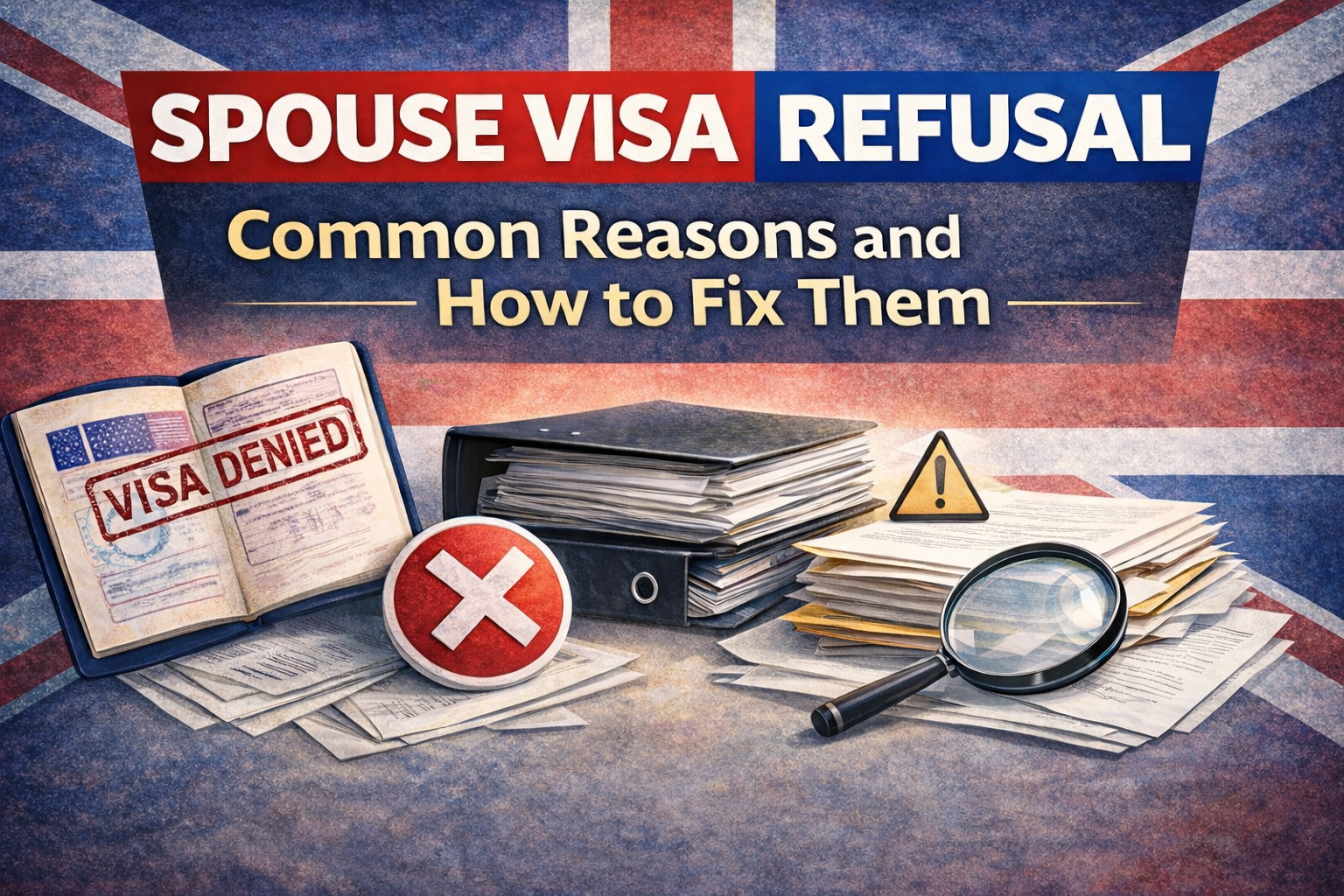
A spouse visa refusal can separate families and create long periods of uncertainty. Refusals often come down to evidence, technical requirements, or credibility concerns rather than the relationship itself.
This guide explains why spouse visas are refused, what a refusal means, and the options available after a negative decision.
What a Spouse Visa Refusal Means
A refusal means the Home Office has decided that the application does not meet the Immigration Rules.
It does not automatically mean:
- the relationship is not genuine
- future applications are impossible
- removal action will start immediately
Each refusal is based on the specific reasons set out in the decision letter.
Understanding those reasons is essential before taking any next step.
Common Reasons for Spouse Visa Refusals
Most refusals fall into a small number of categories.
Financial Requirement Issues
The financial requirement is one of the most common reasons for refusal.
Problems often include:
- income below the required threshold
- incorrect documents
- missing payslips or bank statements
- evidence not covering the required time period
Even small gaps or formatting issues can lead to refusal.
Relationship Evidence Problems
Applicants must show the relationship is genuine and subsisting.
Refusals may arise where:
- evidence is limited or inconsistent
- communication history is unclear
- previous immigration history raises concerns
- interviews reveal contradictions
The Home Office looks at the overall picture, not just marriage certificates.
Accommodation Concerns
Applicants must show adequate accommodation in the UK.
Refusals can occur where:
- housing details are unclear
- tenancy documents are missing
- overcrowding rules are not met
Accommodation issues are often overlooked but regularly relied upon.
English Language Requirement
Failure to meet the English language requirement is another common issue.
This includes:
- using an unapproved test provider
- submitting expired certificates
- applying for an exemption without evidence
Immigration History and Suitability
Previous immigration breaches can affect spouse visa decisions.
This may include:
- overstaying
- previous refusals
- deception findings
- criminal convictions
Suitability issues do not always lead to refusal, but they are closely examined.
The Decision Letter
The refusal letter explains why the application was refused.
It should identify:
- the rules relied upon
- the evidence considered
- whether a right of appeal exists
Some refusals carry a right of appeal, while others require different legal routes.
Deadlines apply, and missing them can limit options.
Does a Spouse Visa Refusal Lead to Removal?
A refusal does not automatically result in removal from the UK.
For applicants outside the UK, the refusal simply means entry clearance was not granted.
For applicants inside the UK, the outcome depends on current immigration status and whether appeal rights apply.
Each situation must be assessed carefully.
Appeal Rights After a Spouse Visa Refusal
Some spouse visa refusals carry a right of appeal, usually where human rights are engaged.
An appeal allows an independent tribunal to review the decision.
Appeals focus on:
- whether the Immigration Rules were applied correctly
- whether the refusal breaches family life rights
Appeals must be lodged within strict time limits.
When an Appeal Is Not Available
Not all refusals carry appeal rights.
In some cases, the only option may be:
- making a fresh application
- requesting an administrative review
- taking further legal steps
Choosing the wrong route can cause delay and additional cost.
Fresh Applications After Refusal
Many spouse visa refusals are resolved through a fresh application.
This involves correcting errors, strengthening evidence, and addressing refusal reasons directly.
A fresh application should not simply repeat the original submission.
Common Mistakes After a Refusal
One common mistake is reapplying without addressing the refusal reasons.
Another is missing appeal deadlines while waiting for advice.
Some applicants also provide new evidence that contradicts earlier statements, which can damage credibility.
Acting quickly but carefully is important.
Criminal Issues and Spouse Visa Refusals
Criminal matters can affect spouse visa decisions, especially where convictions or police involvement are recent.
If an applicant or sponsor is arrested or questioned, this can have immigration consequences.
Statements made to the police may later be relied upon by the Home Office.
Free Police Station Representation
If you are arrested or interviewed by the police during a spouse visa application or after a refusal, you are entitled to legal advice.
Hi Solicitors provide free police station representation. This ensures that your rights are protected and that statements made do not create unnecessary immigration problems later.
Early legal advice at the police station can prevent long-term issues for immigration applications.
Spouse Visa Refusals – FAQs
Can I reapply after a spouse visa refusal?
Yes. Many refusals are resolved through a fresh application, provided the refusal reasons are properly addressed.
Does a refusal mean my relationship is not believed?
Not necessarily. Many refusals are based on technical or evidential issues rather than relationship genuineness.
How long do I have to appeal a refusal?
Appeal deadlines are strict and depend on whether the application was made inside or outside the UK.
Will a refusal affect future applications?
A refusal can affect future applications if the same issues are repeated or if credibility concerns arise.
Can criminal issues affect a spouse visa?
Yes. Criminal history or police involvement can affect suitability assessments.
Do I need a solicitor after a refusal?
Legal advice is not mandatory, but refusals often involve complex rules and deadlines.