Being told the police are taking no further action (NFA) is usually a huge relief. It means you will not be charged, at least for now. But many people are left with questions: does it clear their name, can the case come back, and what happens to the police records, fingerprints and DNA taken when they were arrested?
At Hi Solicitors, our criminal defence solicitors in Bolton advise people at every stage of a police investigation, including after an NFA decision. This guide explains what NFA means in England and Wales, and when a case can be reopened.
What Does No Further Action Mean?
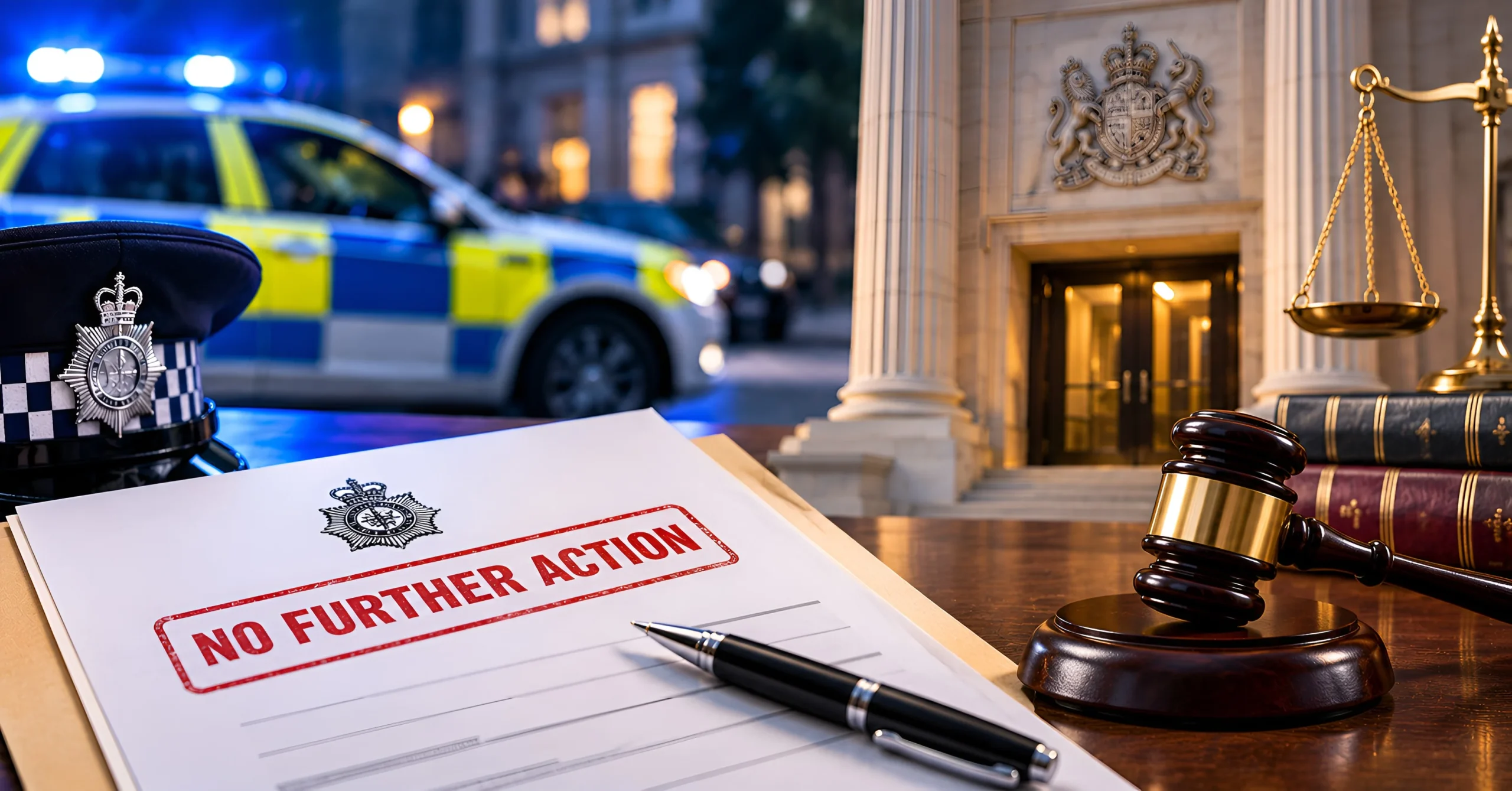
No further action means the police or the Crown Prosecution Service (CPS) have decided not to charge you with the offence they were investigating. The investigation is closed, and if you were on bail or released under investigation, that status ends.
NFA is not a finding of innocence and it is not a conviction. It simply means the case will not go to court on the evidence available at the time.
Why Do the Police Take No Further Action?
Before anyone is charged, prosecutors apply the two-stage test in the Code for Crown Prosecutors. Common reasons for NFA include:
- Not enough evidence. There is not enough evidence to give a realistic prospect of conviction.
- Not in the public interest. Even if there is enough evidence, a prosecution would not be in the public interest.
- The complainant withdraws support. The person who made the allegation no longer wants to support a prosecution, and there is not enough other evidence.
- No offence was committed. The investigation shows that no crime took place.
How Will You Be Told?
You are usually told by phone, letter or email, or through your solicitor. If you were released under investigation or on police bail, you should be told that this has ended. It is sensible to ask for the decision in writing and keep it safe.
Can a Case Be Reopened After No Further Action?
Yes, in some circumstances. An NFA decision is not the same as being found not guilty at trial, so the rule against being tried twice for the same offence does not apply. In practice, most NFA decisions are final, but a case can be reopened in the situations below.
If New Evidence Comes to Light
The police can reopen an investigation if significant new evidence emerges, for example a new witness, forensic results or material from a phone. The CPS can also restart a prosecution where a case was dropped for lack of evidence and significant new evidence has since come to light.
If the Complainant Asks for a Review
Victims have a right to ask for a decision not to charge to be reviewed:
- CPS decisions can be reviewed under the CPS Victims’ Right to Review scheme. A request should normally be made within 10 working days of the decision letter. Requests made more than three months later are unlikely to be accepted except in exceptional circumstances.
- Police decisions are not covered by the CPS scheme and are raised with the police force concerned. Most forces run their own right to review process.
If a review finds the original decision was wrong, a prosecution can be started.
Are There Time Limits?
For summary-only offences, which can only be tried in the magistrates’ court, a prosecution must normally be started within six months of the date of the alleged offence. After that, the case generally cannot be reopened. For more serious offences, there is usually no time limit.
What Happens to Your Records After No Further Action?
Your Arrest Record
Even after NFA, the record of your arrest is normally kept on the Police National Computer (PNC). PNC records are generally retained until a person’s 100th birthday unless they are deleted.
You can apply to have the record deleted through the national Record Deletion Process, run by ACRO. Deletion is not automatic, and applications are usually only successful in limited situations, for example where the arrest was unlawful or it is clear no offence took place.
Your Fingerprints and DNA
Under the Protection of Freedoms Act 2012, fingerprints and DNA profiles taken from someone who is arrested but not charged should normally be destroyed after the decision not to charge. In limited cases involving serious offences, the police can apply to keep them for up to three years.
Will NFA Show on a DBS Check?
- Basic and standard DBS checks show convictions and cautions, not arrests that ended in NFA.
- Enhanced DBS checks, used for jobs such as working with children or vulnerable adults, can include other information held by the police if a senior officer reasonably believes it is relevant. This is rare, but it can happen.
What Should You Do After an NFA Decision?
- Get the decision in writing. Ask the officer in the case for a letter or email confirming NFA. You may need it for an employer, a regulator or an immigration application.
- Collect any property the police kept. If the police seized phones, computers or other items, ask for them to be returned now the investigation is over.
- Avoid contact with the complainant or witnesses about the allegation. This protects you from any suggestion of interference if the case is ever reviewed.
- Consider whether to apply for record deletion. If your arrest should never have happened, a solicitor can advise on applying to have your PNC record, fingerprints and DNA deleted.
- Think about whether your arrest was lawful. If you believe it was not, our guide to suing the police for wrongful arrest explains your options.
How Hi Solicitors Can Help
Our criminal defence team can:
- contact the officer in the case to confirm the outcome and get it in writing
- advise you if a complainant asks for the decision to be reviewed
- represent you if you are asked back for interview or arrested again
- advise on deleting your police records, fingerprints and DNA
If the police contact you again, our police station representation service is available 24 hours a day. Where an arrest or detention was unlawful, our unlawful detention team can advise on a claim.
For confidential advice, call Hi Solicitors on 01204 371 414 or book a free initial consultation.
Frequently Asked Questions
Does no further action mean I am innocent?
Not formally. NFA means you will not be charged on the evidence available. It is not a court finding of innocence, but it does mean you have no conviction for the offence.
Do I need to declare an NFA arrest to an employer?
In most cases you do not have to declare an arrest that ended in NFA, because it is not a conviction or caution. However, some forms, such as certain job, licensing or visa applications, ask about arrests. Always read the question carefully and answer honestly.
Can the police arrest me again for the same offence?
Only if the case is reopened, for example because significant new evidence has emerged. If this happens, get legal advice before any interview.
How long after NFA can a case be reopened?
For summary-only offences, a prosecution must normally start within six months of the alleged offence. For more serious offences there is usually no time limit, but reopening is uncommon without significant new evidence.
Can I get compensation after no further action?
Not automatically. NFA on its own does not entitle you to compensation. You may only have a claim if the arrest or detention itself was unlawful.